Motivation & Psychology•By Felix Smith••12 min read

You know the story. It's practically a script we all follow.
Week one is a blaze of glory. You have the new gear, the killer playlist, and a surge of bulletproof optimism. You are building a new you. Week two, you're still in the fight, riding the high of being 'that person' who has their life together.
And then comes week three.
A long day at work. A rainy evening. The siren song of the couch. You tell yourself the lie you've been waiting to hear: "I'll go tomorrow."
But tomorrow never comes. The momentum is gone. The fire is out. You've quit. Again.
Let's be clear: This is not a personal failure. This is not a sign that you are lazy or undisciplined. You are not broken. You are running a broken system. You have been fighting a war against your own brain's wiring without the right weapons.
It's time to arm yourself. This article will expose the two psychological traps that kill your motivation and give you a simple, three-part framework to build a system that makes consistency your default setting.
The Main Villain: The "All-or-Nothing" Mindset
The first enemy you must defeat is the destructive voice in your head that whispers, "You missed your Monday workout, so the whole week is a write-off. Start fresh next Monday."
This is the all-or-nothing mindset, a common cognitive distortion that forces you into one of two boxes: perfect success or total failure. It's the saboteur that tells you because you ate one cookie, you might as well eat the whole sleeve.

Think about how absurd this is. It's like a sculptor who, upon noticing a small imperfection in their masterpiece, decides to destroy the entire beautiful statue with a hammer. It makes zero logical sense, but it feels emotionally right in a moment of frustration. Why? Because it's an ego-defense mechanism. If you declare the week a "failure" and quit on your own terms, you protect yourself from the discomfort of an imperfect performance.
You are choosing to fail to avoid the feeling of failure. You must stop making this choice.
The Silent Accomplice: The Motivation Cliff
Your second enemy is more subtle. It's the natural, inevitable decline of your initial excitement. Your brain loves novelty. Starting something new delivers a powerful dopamine hit, a chemical reward for experiencing something new and interesting.
But when that novelty wears off, you are left with only the work. This is the Motivation Cliff. It's the point where the perceived effort outweighs the fading excitement. You stand at the edge, look down at the hard work below, and decide to turn back.
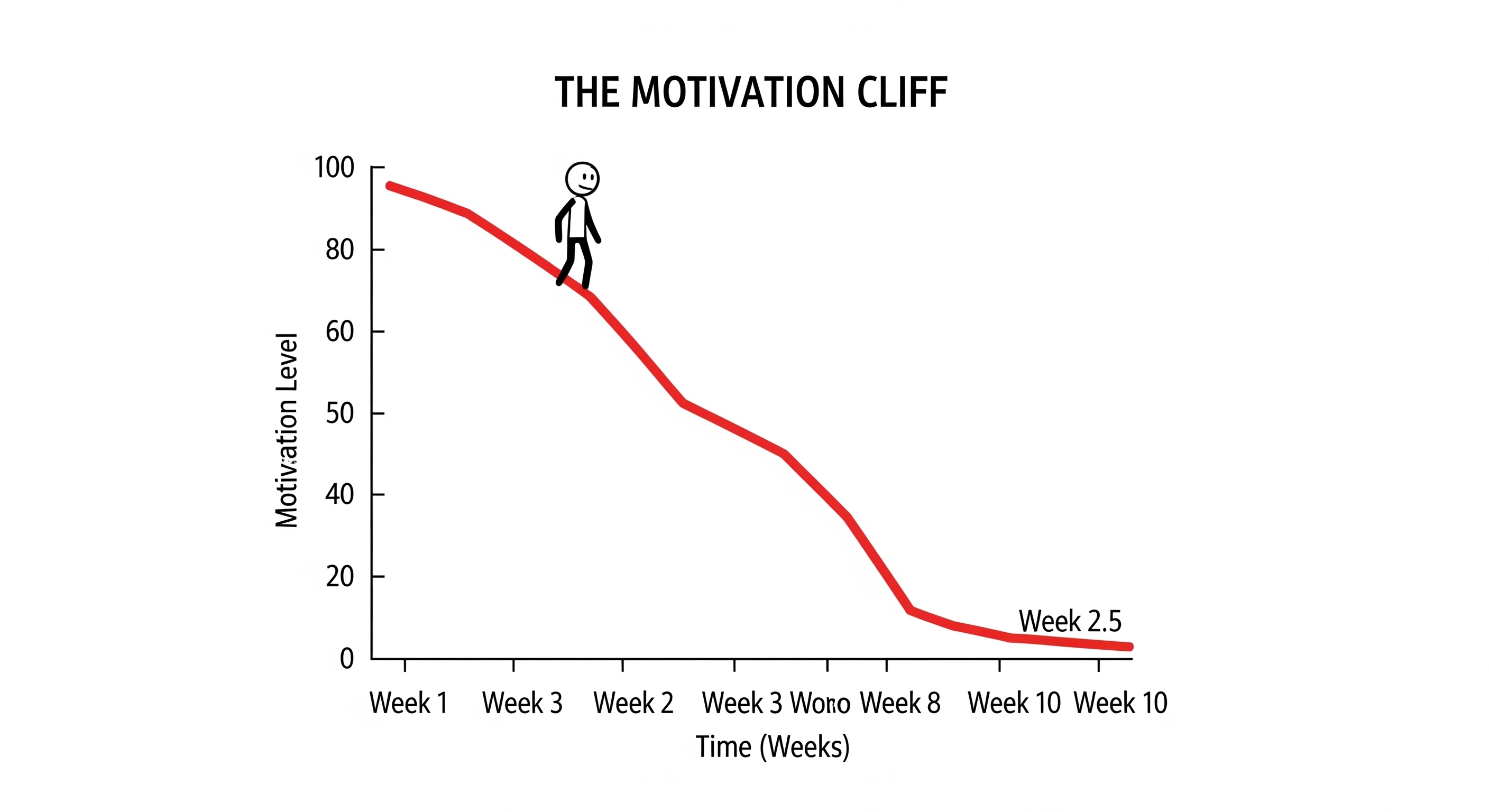
This is made worse by vague goals. An ambition like "get in shape" is an invisible finish line. Your mind isn't motivated by abstract ideas; it's motivated by clear targets and tangible rewards. Without a daily finish line to cross, the work feels endless and the cliff looks impossibly high.
The Antidote: A 3-Part Framework for a Bulletproof System
You will not win this war with more willpower. You will win it with a better system. Here are the three non-negotiable rules for your new system.
Part 1: Never Miss Twice
This is your new code, a concept popularized by James Clear in his book Atomic Habits. The law is simple: perfection is not the goal; consistency is. Missing one workout is an accident—life happens. Missing two is a choice. It is the beginning of a new habit of quitting. Your only job after a missed day is to do something the next day. A 20-minute walk. Ten push-ups. It doesn't matter what. You are not training your body; you are training your mind. You are showing it that one setback does not break the chain of your new identity.
Part 2: Lower the Bar
You must make the act of starting ridiculously easy. Your goal is not "run three miles." Your new goal is "put on your running shoes and walk out the door." That's it. That is the new definition of a win. Anything that happens after that—a one-mile run, a three-mile run—is just bonus credit. Train your mind like a dog. You give it a simple command it can obey, and you reward it instantly by letting it feel the victory of having shown up.
Part 3: Add Real Stakes
This is the final piece that makes the system unbreakable. You must understand a fundamental truth of human psychology: we are twice as motivated to avoid a loss as we are to achieve a gain. This is a Nobel Prize-winning concept called Loss Aversion. The vague promise of "getting a six-pack" in three months is a weak motivator compared to the immediate, tangible pain of losing $10 right now.

You must attach a small, meaningful consequence to your inaction. You have to give your future self a reason to listen to your current intentions. You must put something on the line.
From Willpower to a Winning System
Stop trying to force yourself. Stop relying on the fickle emotion of motivation. The path to consistency is not paved with more willpower, but with a better system.
To recap, that system is:
- 1.Never Miss Twice.
- 2.Make starting ridiculously easy.
- 3.Add real, immediate stakes.
Building this system and holding yourself to it is the real work. You can create it with a calendar, a journal, and a commitment to a friend. The key is to stop blaming yourself and start designing a framework that accounts for your own psychology.
For those who want to automate this process, tools can help. That's the idea behind our app, Step Up Or Pay Up. It's designed to be a simple way to implement this exact framework: it tracks your goals, operates on the "never miss twice" principle, and helps you add real stakes.
Whatever tools you choose, the lesson is the same: build a system, and you'll finally build the consistency you've been searching for.